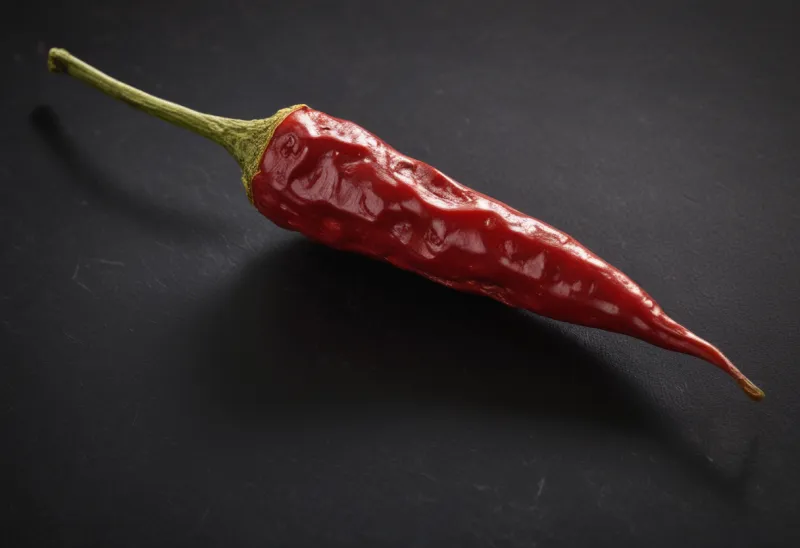
Yes, by roughly 50 to 70 calories a day — and the burning may not be the part doing it#
Eating chili raises energy expenditure. Pooling nine human studies, capsaicin and its analogs increased daily expenditure by 245 kJ — 58.56 kcal a day — and lowered the respiratory quotient by 0.216, indicating a shift toward burning fat2. That is a real, measured effect and it is about one large apple's worth of calories, spent over 24 hours.
The more interesting finding is buried one level down, and it inverts the whole folk story. When an earlier meta-analysis separated pungent capsaicin — the molecule that makes your mouth burn — from capsiate, a non-pungent analog found in CH-19 Sweet peppers, only the non-pungent one held up. Capsaicin's overall effect on energy expenditure was not significant (SMD 0.11, 95% CI −0.06 to 0.29); capsiate's was (SMD 0.40, 95% CI 0.22 to 0.59)1.
The compound that makes food hot is the one whose thermogenic effect does not survive pooling. The one that does survive is a molecule you cannot taste — and cannot get from hot sauce.
The pillar on what metabolism actually is sets out why nothing on a spice rack can move total expenditure much. This article is about a narrower question: given that the effect is small, is it even the effect people think it is? The short version of the summary case — roughly +50 kcal a day of burn and about 74 kcal off the next meal — lives in metabolism-boosting foods. What follows is the structure underneath it.
The split nobody mentions: capsaicin versus capsiate#
Ludy, Moore and Mattes ran separate meta-analyses on the two compounds rather than lumping them, which is why their result is more informative than the headline number.
| Compound | Effect on energy expenditure | Where it shows up |
|---|---|---|
| Capsaicin (pungent) | SMD 0.11 (95% CI −0.06 to 0.29) — not significant overall | High doses only: SMD 0.56 (0.06–1.05) |
| Capsiate (non-pungent) | SMD 0.40 (95% CI 0.22 to 0.59) — significant | Intermediate and high doses |
Both compounds enhanced fat oxidation at sufficient doses. But the energy-expenditure column is the one people are buying, and it says that the pungent version needs a high dose before it does anything detectable at all, while the tasteless analog works from an intermediate one.
That matters practically, because the tasteless analog is a supplement, not a meal. Capsiate is presented in this literature explicitly as an alternative for people who do not like spicy food — a capsule, not a curry. If you are eating chili because you read that it boosts metabolism, you are consuming the compound with the weaker evidence, in the form with the lower dose.
Where the calories concentrate, and how fragile the result is#
Zsiborás and colleagues did the other useful piece of stratification. Their overall +58.56 kcal/day splits cleanly by body size:
- Participants with mean BMI above 25: energy expenditure up 292 kJ/day (69.79 kcal/day, p = 0.023); respiratory quotient down 0.257 (p = 0.036).
- Participants with mean BMI below 25: no significant effect on energy expenditure (p = 0.718) or on respiratory quotient (p = 0.444).
So the effect is not a general property of chili. It is a property of chili in heavier people, and it is absent — statistically, entirely — in lean ones.
It is also worth reading the p-values rather than the headline. The overall results sit at p = 0.030 and p = 0.031, drawn from nine studies. That is a result that clears the conventional threshold and would not survive much perturbation: one more null trial, or one fewer positive one, and it would not be reportable. Small pooled effects assembled from single-digit study counts are the class of finding that most often shrinks when the field grows. This one may hold; it has not been stress-tested.
Which also explains the apparent conflict between the two meta-analyses. Ludy's found nothing significant for capsaicin; Zsiborás's found +58.56 kcal/day. They are not measuring the same thing: Zsiborás pooled capsaicin and capsinoids together, so part of their positive result is the capsiate effect Ludy also found, and their signal comes almost entirely from a higher-BMI subgroup Ludy did not separate out.
You cannot blind a burn#
There is a methodological problem specific to this literature that does not apply to, say, caffeine or the thermic effect of protein: the intervention announces itself.
The doses at which anything happens are substantial. Ludy's review puts effective ranges at 20–150 mg of capsaicin or 3–10 mg of capsiate. At the top of the capsaicin range the tolerability data are telling: in one study dosing 135 mg a day, all participants mentioned a burning feeling, and 24 percent reduced their dose because of gastric distress.
Draw the consequence out — this is our inference, not the authors' claim. If every participant can identify their allocation from the first mouthful, the trial is functionally unblinded, and the outcomes most vulnerable to that are exactly the self-reported ones: hunger ratings, fullness, how much you decide to serve yourself next. Thermogenesis measured by a metabolic cart is safe from expectancy. Appetite questionnaires are not. Since the appetite side of the capsaicin case is the larger of the two effects, the larger effect is also the one resting on the weaker methodology — and it is a reason to be more cautious about spice as an appetite tool than the effect size alone suggests. Capsiate, notably, offered better tolerability precisely because it is not pungent, which is also what makes it blindable.
Who funded which half of this evidence base#
Both halves of this literature have an interested party attached, and the standard is the same in both directions.
The Ludy review — the one that deflates pungent capsaicin — states its support verbatim as coming from an NIH training award "and the McCormick Science Institute." McCormick is a spice company; its research institute funds work on the health properties of spices. The finding here runs partly against that interest, which is a point in the paper's favour, but the reader is entitled to know.
The capsinoid side is more concentrated. One of the studies establishing that capsinoids raise resting expenditure and fat oxidation in people with high BMI — 44 subjects, four weeks, 3 or 10 mg/kg — was authored from the Ajinomoto Research Institute for Health Fundamentals4. Ajinomoto is the food company that developed and sells capsinoid products. The effect that survived meta-analysis is, in meaningful part, an effect demonstrated by the manufacturer of the compound.
None of that makes the results wrong. It does mean the cleanest-looking finding in this field — that the tasteless supplement outperforms the food — has a commercial gradient running in the same direction, and the independent replication base is thin.
What any of it does to the scale#
The endpoint people care about has been pooled, and it is the smallest number in this article. Across 15 randomized controlled trials in 762 overweight and obese adults, capsaicin supplementation produced a weighted mean difference in body weight of −0.51 kg (95% CI −0.86 to −0.15), with BMI down 0.25 kg/m² and waist circumference down 1.12 cm3. The authors' own word for it is "modest."
Half a kilogram. That is what the entire capsaicin literature delivers at the outcome that motivated it, and the lower end of the confidence interval is 150 grams.
That figure is not in conflict with the thermogenesis result; it is what the thermogenesis result looks like once the body has had months to respond to it. A 58-calorie daily bump does not accumulate the way arithmetic promises, for the same reasons cold exposure doesn't: expenditure elsewhere adjusts, and intake adjusts faster than either.
So eat chili. It is a genuine pleasure, it makes low-calorie food taste like something, and there is no reason to avoid it. Just do not put it in the budget — half a kilogram over months of supplementation is a rounding error you would not notice on the scale, and it is the ceiling, not the expectation.
FAQ#
Does hot sauce actually burn calories?#
A little, and less reliably than the supplement version. Pooled across studies, pungent capsaicin showed no statistically significant overall effect on energy expenditure (SMD 0.11, 95% CI −0.06 to 0.29) — only at high doses did it register. The non-pungent analog capsiate did show a significant effect. Whatever thermogenesis you get from a bottle of hot sauce is real in principle and too small and too dose-dependent to detect in your own weight.
How much chili would you have to eat to hit the doses used in studies?#
Enough that the studies themselves report side effects. Effective ranges in this literature run 20–150 mg of capsaicin a day, and at 135 mg a day every participant in one trial reported burning, with 24 percent cutting their dose over gastric distress. That is a supplement schedule, not a seasoning habit — which is a large part of why the food doesn't reproduce the supplement's numbers.
Why do capsaicin supplements outperform spicy food in the research?#
Three reasons stack up. The dose is far higher and more consistent than anything you would season with. The non-pungent form, capsiate, is the one with the significant pooled effect on energy expenditure, and it exists only as a supplement. And a tasteless capsule can be properly blinded against a placebo, while a mouthful of chili cannot — so supplement trials produce cleaner data as well as bigger doses.
Sources#
- Ludy MJ, Moore GE, Mattes RD. The effects of capsaicin and capsiate on energy balance: critical review and meta-analyses of studies in humans. Chem Senses. 2012;37(2):103-121.
- Zsiborás C, Mátics R, Hegyi P, et al. Capsaicin and capsiate could be appropriate agents for treatment of obesity: a meta-analysis of human studies. Crit Rev Food Sci Nutr. 2018;58(9):1419-1427.
- Zhang W, Zhang Q, Wang L, Zhou Q, Wang P, Qing Y, Sun C. The effects of capsaicin intake on weight loss among overweight and obese subjects: a systematic review and meta-analysis of randomised controlled trials. Br J Nutr. 2023;130(9):1645-1656.
- Inoue N, Matsunaga Y, Satoh H, Takahashi M. Enhanced energy expenditure and fat oxidation in humans with high BMI scores by the ingestion of novel and non-pungent capsaicin analogues (capsinoids). Biosci Biotechnol Biochem. 2007;71(2):380-389.
Source: BurnWeek — "Do spicy foods really boost your metabolism?", https://burnweek.fit/blog/does-spicy-food-boost-metabolism/. Licensed CC BY 4.0: free to quote or reuse with a link to this page.