# Photo vs. voice calorie tracking: what's actually the best way to log food?
October 24, 2026 · Calorie Tracking · 10 min read · https://burnweek.fit/blog/photo-vs-voice-calorie-tracking/
> A tablespoon of oil adds about 133 kcal and never shows up in the photo. Pick the logging method by where the information about your meal actually lives.
**Key takeaways**
- A single photo can't see depth or hidden fat: a tablespoon of oil (about 15 g) adds roughly 133 kcal that a photo of the finished dish doesn't show.
- Saying a meal is the most informative option when you know weights, cooking fat and recipe; a photo is the better start when you don't.
- Random portion misses partly cancel over days; a habit like never mentioning butter biases every entry the same way.
- Portion-guessing training helps for about four weeks and fades without repetition; occasional guess-then-weigh checks keep it calibrated.
- For packaged food, scan the barcode and say how much you ate; for a home-cooked pot, the raw ingredients set the calories and the cooked weight sets the portion.
## A photo records how food looks; a sentence carries what you know
Lunch is cooked buckwheat, a baked chicken breast and a cucumber salad. You can photograph it, or you can say: "200 grams of cooked buckwheat with 5 grams of butter, about 150 grams of chicken breast baked without oil, 100 grams of cucumber." Both take seconds, but they hand over different information. The photo shows what is on the plate. The sentence carries what you know about it: how much, cooked in what, and what you left.
So the real question is where the information about this meal lives. When you know the meal, say it. When the package knows it, scan it. When only the plate knows it, photograph it and add what a camera can't see. When nobody knows it yet, as with a restaurant curry or a pot that fed you for three days, talk it through.
| One lunch, four ways | What it captures well | What it can't capture |
|---|---|---|
| Photo | Which foods, how they are arranged, roughly how much area they cover | Depth, weight, oil, butter, what's under the sauce |
| Saying it | Weights you know, cooking method, added fats, what you left | Anything you don't know or forget to mention |
| Barcode (a packaged version) | The manufacturer's per-100 g figures | How much of the package you ate |
| Talking it through with an assistant | A recipe rebuilt from ingredients, with the unknowns named | Precision you never had; it works with your answers |
## What a single photo can't see
Recognizing the food is the easy part for image systems. Portion size is hard, for a geometric reason: a photo flattens a pile onto a plane, so a shallow bowl and a deep one look the same from above. A systematic review of mobile food-recognition apps names "view occlusion and scale ambiguity" as recurring problems and notes that depth-sensing fixes had yet to be fully tested in real phone apps ([Amugongo et al., 2022](https://pubmed.ncbi.nlm.nih.gov/36611519/)). Extra photos from other angles help, though the same review calls taking several before every meal "tedious".
The second blind spot is fat. Olive oil is 884 kcal per 100 g ([USDA FoodData Central](https://fdc.nal.usda.gov/portal-data/external/171413)), so a tablespoon (about 15 g) brushed on a chicken breast adds roughly 133 kcal that the photo doesn't show. The breast itself, 150 g grilled, is about 227 kcal ([USDA FoodData Central](https://fdc.nal.usda.gov/portal-data/external/171534)). More on what cameras miss is in [how accurate AI photo calorie counters are](/blog/how-accurate-are-ai-photo-calorie-counters).
Two things a photo of the plate can't see
Illustrative bowls, not measured portions. The chicken and oil figures are USDA values: 15 g of oil on 150 g of grilled breast.
Photos are still quick, and they catch meals you'd otherwise forget. But a photo answers "what", and you are often the only source for "how much" and "cooked in what".
## Saying it: quick when you know the meal, and only as good as what you say
When you made the meal, you hold what the camera lacks, and saying it takes as long as the sentence:
- "Two scrambled eggs with five grams of butter, two slices of toast, coffee with 100 ml of milk."
- "My usual Greek yogurt, 250 grams, with 60 grams of raspberries."
There's no food list to search, which is the slowest part of database logging (see [typing or saying a meal in your own words](/blog/logging-food-in-your-own-words)). Our founder has logged this way for about a year, and a plain description like the breakfast above feels like it takes under ten seconds. His own logs are less flattering. Across 120 voice-logged meals between September 12 and October 22, 2026, the median time from starting to speak to the meal being saved was 15 seconds; about one in five took under 10 seconds, and 83% under 30. Most of that is talking: after he stopped speaking, the median wait was about 3 seconds (216 logs, July 15 to October 22). That's one experienced user, timed from his first word, not a study; it leaves out unlocking the phone and any fixing afterwards.
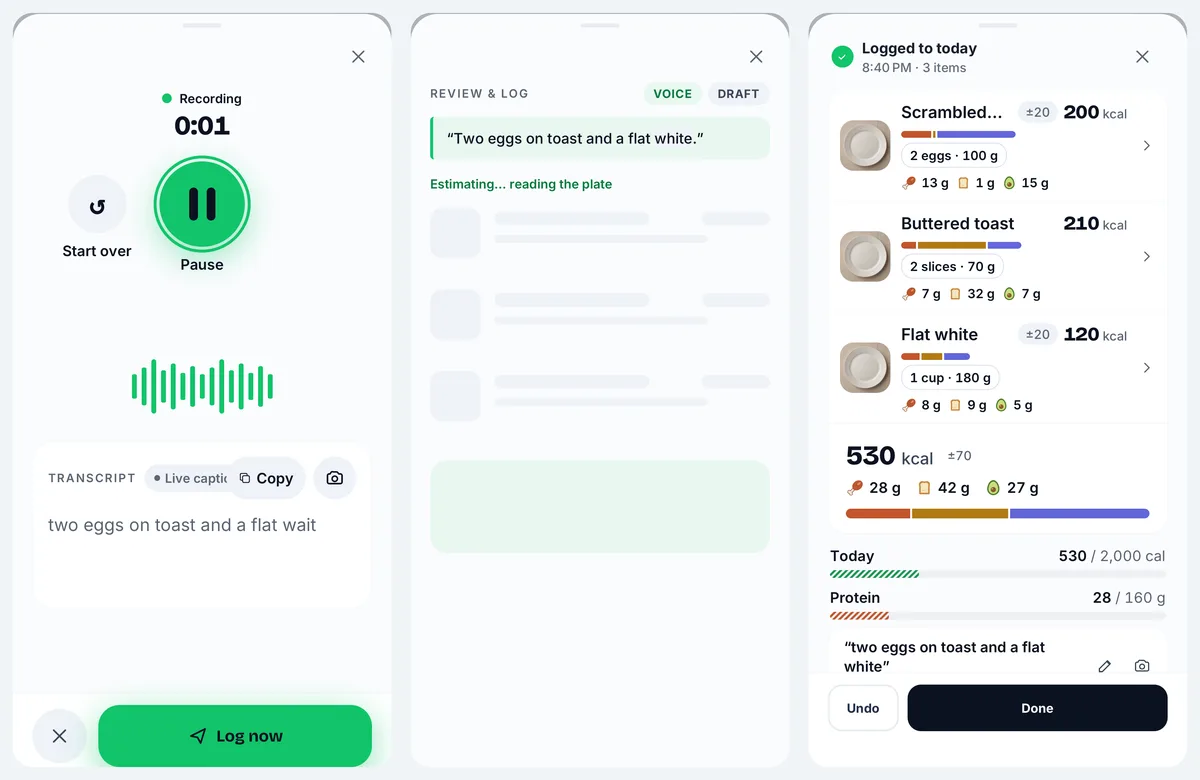
In BurnWeek, your words appear as live captions, and you can tap them to fix a misheard word. One tap logs the meal; the result lists each food with its portion and calories, plus Undo. You check after logging rather than before, so nothing waits on a confirmation screen.
Speak, log, check
Real app screens from a test build with sample meals. The live caption misheard "flat white" as "flat wait"; the final transcript fixed it before estimating.
Speech recognition isn't equally good for everyone. In a test of five commercial recognizers, the average word error rate was 0.35 for Black speakers and 0.19 for white speakers ([Koenecke et al., 2020](https://pubmed.ncbi.nlm.nih.gov/32205437/)). Accents, noise, rare dish names and switching languages mid-sentence all raise the odds of a misheard word, which is why the captions stay visible and editable.
The app runs in English, Estonian and Russian, and you can mix them in one breath: "200 grams of гречка, cooked, with 5 grams of butter, and two chicken котлеты." Local food names a database search would miss are often the easiest to say, though mixed-language speech is misheard more often, so glance at the captions.
## Your estimates: random misses partly cancel, a missing spoon of oil doesn't
"About 150 grams" without a scale is a guess, and guesses miss. What matters is the kind of miss. Dietary researchers separate random error, which "can usually be mitigated through large-enough sample sizes and repeat measures", from systematic error, which pushes every entry the same way ([Subar et al., 2015](https://pubmed.ncbi.nlm.nih.gov/26468491/)). Rice guessed 20 g high on Monday and 20 g low on Thursday washes out. Butter you never mention is missing every time.
Random misses average out; a habit doesn't
Illustrative, not data. Dots are daily logs; the green marker is their average.
That's the case for listing a plate's parts. Item guesses partly cancel across a meal anyway; the gain is a checklist. "150 g chicken, 200 g rice, 100 g vegetables, 20 g sauce" gives the sauce and the cooking fat their own line instead of letting them drop out.
Guessing also improves with feedback: guess, weigh, compare, now and then. A 150 g guess that weighs 190 g teaches you something about your rice. A systematic review found that portion-size training improved accuracy over the short term, around four weeks, that "repeated training is needed to maintain skills", and that shapeless foods like rice and pasta stayed hardest ([Hooper et al., 2019](https://pubmed.ncbi.nlm.nih.gov/30629097/)). Not every method works: in one randomized study, a web tutorial mostly moved people from underestimating to overestimating rather than making them more accurate ([Riley et al., 2007](https://pubmed.ncbi.nlm.nih.gov/17346654/)). Your own food on your own scale is the better lesson; the method is in [when to weigh food and when an estimate is enough](/blog/when-to-weigh-food-and-when-to-estimate).
## Packaged food: scan it, then say how much
For packaged food, the label knows more than a photo can. The scan gives the declared nutrition per 100 g; what it can't give is how much you ate, which is usually easy to say.
| Package | What you ate | What to log |
|---|---|---|
| Greek yogurt, 400 g tub | Half | 200 g |
| Chocolate bar, 100 g | A quarter | 25 g |
| Pasta, 500 g bag, cooked for four | One share | 125 g dry weight |
In BurnWeek, a scan offers half the pack when the pack size is known, and you can type any other amount in grams. Product databases aren't flawless: recipes change under the same barcode, and some entries are wrong (see [are barcode scans as accurate as they seem](/blog/barcode-scanning-accuracy)). In a validation of a large consumer app's food database against Belgium's food composition table, 2.8% of the logged data exceeded plausibility limits and was removed, and after that cleaning, energy totals correlated at r = 0.96 with the reference ([Evenepoel et al., 2020](https://pubmed.ncbi.nlm.nih.gov/33084583/)). A number that looks absurd probably is.
## Restaurant plates and home recipes: a photo with a sentence, or a conversation
At a restaurant you rarely know weights or what went into the sauce, so the photo earns its place: it records the dish and its size. Add the sentence the camera can't supply: "chicken tikka wrap from an Indian place, creamy sauce, ate all of it." A side shot shows thickness. The estimate will still be a range, as it should be.
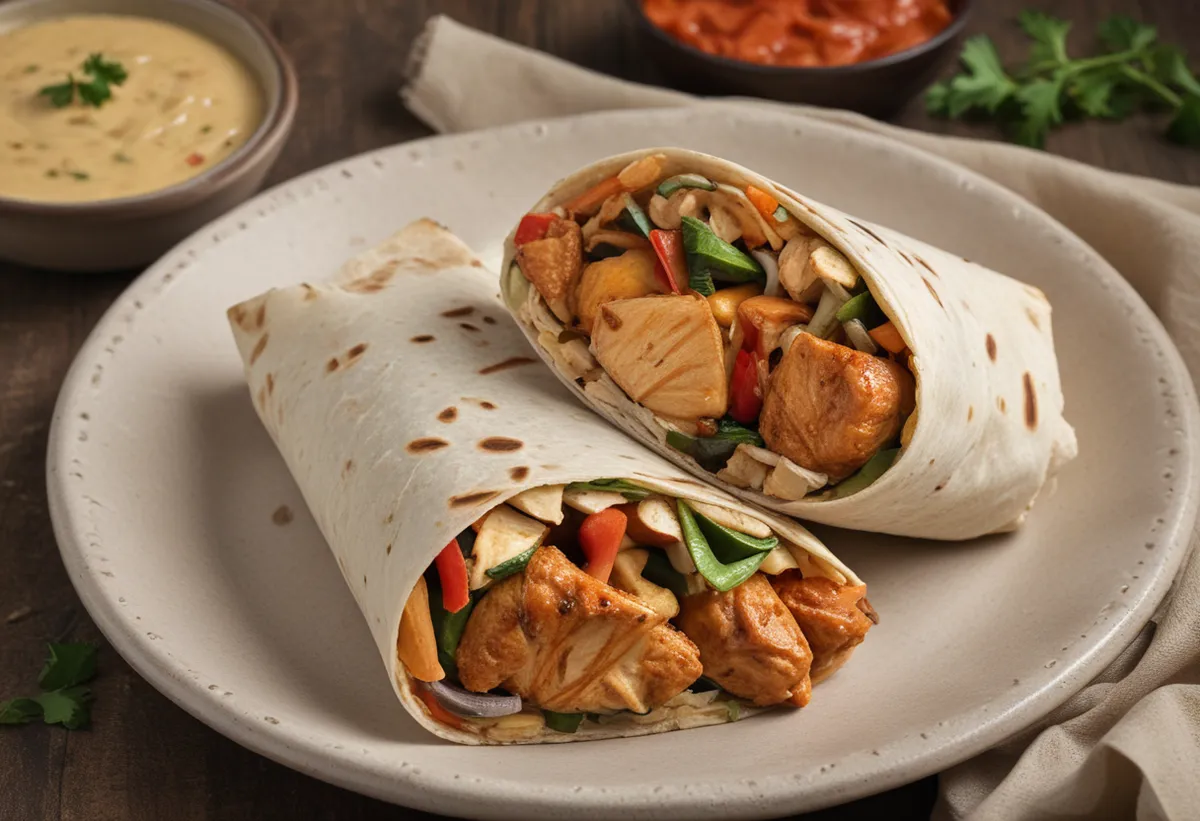
*Illustrative image. Cut open, a wrap shows its filling; photographed whole from above, it shows a tortilla. Neither shows how much sauce went in.*
With more unknowns, a conversation helps. With BurnWeek connected to ChatGPT or Claude, you can send the photo, say what you know, and ask the assistant to question you first. Good questions target the biggest uncertainties (how much sauce, fried or not, finished or not); garnish barely matters. If you want the numbers before anything is saved, say so ("work it out with me, log it when I say"); otherwise the assistant logs straight away and you fix it afterwards.
A conversation can also rebuild a home-cooked pot: 500 g of raw chicken breast, 250 g of dry rice, two carrots, 15 g of oil, and you ate about a third. The ingredients carry the energy; cooking mostly moves water. Rice absorbs it, chicken loses some, and the pot's weight changes while its calories stay close to the sum of what went in. The USDA describes cooking yields as changes in food weight from "moisture loss", "water absorption" and fat gains or losses ([USDA, 2014](https://www.ars.usda.gov/ARSUserFiles/80400535/Data/retn/USDA_CookingYields_MeatPoultry02.pdf)). Weigh the cooked pot once and "a third" becomes a weight. A real chat doing this is in [from a ChatGPT recipe to tomorrow's dinner](/blog/chatgpt-recipe-to-tomorrows-dinner).
Raw ingredients vs the cooked pot
Illustrative cooked weights; the real gain depends on how much water the rice took up. Energy uses USDA raw values: chicken breast 120, dry white rice 365, carrots 41 and olive oil 884 kcal per 100 g.
## Which method for which meal
Pick the method by where the information lives
Work down the list and stop at the first yes.
The order matters: a label beats your description of a packaged food, and your description of a meal you cooked beats a photo of it. No single log has to be perfect. A log becomes useful over months when the repeat gaps (the oil, the sauce, the second helping) get mentioned, and when logging stays easy enough to keep doing. The habit itself is covered in our [beginner's guide to counting calories](/blog/how-to-count-calories).
## FAQ
### Is voice logging more accurate than photo logging?
Not as a rule. Saying a meal is more informative when you know the weights, the cooking fat and the recipe. A photo is better when you don't, because it at least records the dish and its size. The most accurate log of a home-cooked meal is usually a description with weights you actually measured.
### Can a photo show how much oil or butter is in a meal?
Rarely. Fat absorbed into food or pooled under it doesn't show from above, and a tablespoon of oil is about 133 kcal. If you know a meal was cooked in oil or butter, say how much, even as a rough guess.
### Can I mix languages when I log by voice?
Yes, you can mix English, Estonian and Russian in one sentence, and local food names often work better spoken than searched. Mixed-language speech is misheard more often, so glance at the captions before you tap log.
## Sources
- [Amugongo LM, Kriebitz A, Boch A, Lütge C. Mobile computer vision-based applications for food recognition and volume and calorific estimation: a systematic review. Healthcare (Basel). 2022;11(1):59.](https://pubmed.ncbi.nlm.nih.gov/36611519/)
- [Koenecke A, Nam A, Lake E, et al. Racial disparities in automated speech recognition. Proc Natl Acad Sci U S A. 2020;117(14):7684-7689.](https://pubmed.ncbi.nlm.nih.gov/32205437/)
- [Subar AF, Freedman LS, Tooze JA, et al. Addressing current criticism regarding the value of self-report dietary data. J Nutr. 2015;145(12):2639-2645.](https://pubmed.ncbi.nlm.nih.gov/26468491/)
- [Hooper A, McMahon A, Probst Y. The role of various forms of training on improved accuracy of food-portion estimation skills: a systematic review of the literature. Adv Nutr. 2019;10(1):43-50.](https://pubmed.ncbi.nlm.nih.gov/30629097/)
- [Riley WT, Beasley J, Sowell A, Behar A. Effects of a web-based food portion training program on food portion estimation. J Nutr Educ Behav. 2007;39(2):70-76.](https://pubmed.ncbi.nlm.nih.gov/17346654/)
- [Evenepoel C, Clevers E, Deroover L, Van Loo W, Matthys C, Verbeke K. Accuracy of nutrient calculations using the consumer-focused online app MyFitnessPal: validation study. J Med Internet Res. 2020;22(10):e18237.](https://pubmed.ncbi.nlm.nih.gov/33084583/)
- [U.S. Department of Agriculture, Agricultural Research Service. USDA Table of Cooking Yields for Meat and Poultry, Release 2. 2014.](https://www.ars.usda.gov/ARSUserFiles/80400535/Data/retn/USDA_CookingYields_MeatPoultry02.pdf)
- [USDA FoodData Central. Oil, olive, salad or cooking (FDC 171413, SR Legacy).](https://fdc.nal.usda.gov/portal-data/external/171413)
- [USDA FoodData Central. Chicken, broiler or fryers, breast, skinless, boneless, meat only, cooked, grilled (FDC 171534, SR Legacy).](https://fdc.nal.usda.gov/portal-data/external/171534)
- [USDA FoodData Central. Chicken, broiler or fryers, breast, skinless, boneless, meat only, raw (FDC 171077, SR Legacy).](https://fdc.nal.usda.gov/portal-data/external/171077)
- [USDA FoodData Central. Rice, white, long-grain, regular, raw, unenriched (FDC 169756, SR Legacy).](https://fdc.nal.usda.gov/portal-data/external/169756)
- [USDA FoodData Central. Carrots, raw (FDC 170393, SR Legacy).](https://fdc.nal.usda.gov/portal-data/external/170393)
Source: BurnWeek — "Photo vs. voice calorie tracking: what's actually the best way to log food?", https://burnweek.fit/blog/photo-vs-voice-calorie-tracking/. Licensed CC BY 4.0: free to quote or reuse with a link to this page.